 Add to Chrome
 Add to Firefox
 Add to Edge
OmniNFT: Modality-wise Omni Diffusion Reinforcement for Joint Audio-Video Generation
May 12, 2026
Recent advances in joint audio-video generation have been remarkable, yet real-world applications demand strong per-modality fidelity, cross-modal alignment, and fine-grained synchronization. Reinforcement Learning (RL) offers a promising paradigm, but its extension to multi-objective and multi-modal joint audio-video generation remains unexplored. Notably, our in-depth analysis first reveals that the primary obstacles to applying RL in this stem from: (i) multi-objective advantages inconsistency, where the advantages of multimodal outputs are not always consistent within a group; (ii) multi-modal gradients imbalance, where video-branch gradients leak into shallow audio layers responsible for intra-modal generation; (iii) uniform credit assignment, where fine-grained cross-modal alignment regions fail to get efficient exploration. These shortcomings suggest that vanilla RL fine-tuning strategy with a single global advantage often leads to suboptimal results. To address these challenges, we propose OmniNFT, a novel modality-aware online diffusion RL framework with three key innovations: (1) Modality-wise advantage routing, which routes independent per-reward advantages to their respective modality generation branches. (2) Layer-wise gradient surgery, which selectively detaches video-branch gradients on shallow audio layers while retaining those for cross-modal interaction layers. (3) Region-wise loss reweighting, which modulates policy optimization toward critical regions related to audio-video synchronization and fine-grained alignment. Extensive experiments on JavisBench and VBench with the LTX-2 backbone demonstrate that OmniNFT achieves comprehensive improvements in audio and video perceptual quality, cross-modal alignment, and audio-video synchronization.

Awaking Spatial Intelligence in Unified Multimodal Understanding and Generation
May 05, 2026We present JoyAI-Image, a unified multimodal foundation model for visual understanding, text-to-image generation, and instruction-guided image editing. JoyAI-Image couples a spatially enhanced Multimodal Large Language Model (MLLM) with a Multimodal Diffusion Transformer (MMDiT), allowing perception and generation to interact through a shared multimodal interface. Around this architecture, we build a scalable training recipe that combines unified instruction tuning, long-text rendering supervision, spatially grounded data, and both general and spatial editing signals. This design gives the model broad multimodal capability while strengthening geometry-aware reasoning and controllable visual synthesis. Experiments across understanding, generation, long-text rendering, and editing benchmarks show that JoyAI-Image achieves state-of-the-art or highly competitive performance. More importantly, the bidirectional loop between enhanced understanding, controllable spatial editing, and novel-view-assisted reasoning enables the model to move beyond general visual competence toward stronger spatial intelligence. These results suggest a promising path for unified visual models in downstream applications such as vision-language-action systems and world models.
Thinking in Structures: Evaluating Spatial Intelligence through Reasoning on Constrained Manifolds
Feb 08, 2026Spatial intelligence is crucial for vision--language models (VLMs) in the physical world, yet many benchmarks evaluate largely unconstrained scenes where models can exploit 2D shortcuts. We introduce SSI-Bench, a VQA benchmark for spatial reasoning on constrained manifolds, built from complex real-world 3D structures whose feasible configurations are tightly governed by geometric, topological, and physical constraints. SSI-Bench contains 1,000 ranking questions spanning geometric and topological reasoning and requiring a diverse repertoire of compositional spatial operations, such as mental rotation, cross-sectional inference, occlusion reasoning, and force-path reasoning. It is created via a fully human-centered pipeline: ten researchers spent over 400 hours curating images, annotating structural components, and designing questions to minimize pixel-level cues. Evaluating 31 widely used VLMs reveals a large gap to humans: the best open-source model achieves 22.2% accuracy and the strongest closed-source model reaches 33.6%, while humans score 91.6%. Encouraging models to think yields only marginal gains, and error analysis points to failures in structural grounding and constraint-consistent 3D reasoning. Project page: https://ssi-bench.github.io.
MaskFocus: Focusing Policy Optimization on Critical Steps for Masked Image Generation
Dec 21, 2025Reinforcement learning (RL) has demonstrated significant potential for post-training language models and autoregressive visual generative models, but adapting RL to masked generative models remains challenging. The core factor is that policy optimization requires accounting for the probability likelihood of each step due to its multi-step and iterative refinement process. This reliance on entire sampling trajectories introduces high computational cost, whereas natively optimizing random steps often yields suboptimal results. In this paper, we present MaskFocus, a novel RL framework that achieves effective policy optimization for masked generative models by focusing on critical steps. Specifically, we determine the step-level information gain by measuring the similarity between the intermediate images at each sampling step and the final generated image. Crucially, we leverage this to identify the most critical and valuable steps and execute focused policy optimization on them. Furthermore, we design a dynamic routing sampling mechanism based on entropy to encourage the model to explore more valuable masking strategies for samples with low entropy. Extensive experiments on multiple Text-to-Image benchmarks validate the effectiveness of our method.
Group Critical-token Policy Optimization for Autoregressive Image Generation
Sep 26, 2025Recent studies have extended Reinforcement Learning with Verifiable Rewards (RLVR) to autoregressive (AR) visual generation and achieved promising progress. However, existing methods typically apply uniform optimization across all image tokens, while the varying contributions of different image tokens for RLVR's training remain unexplored. In fact, the key obstacle lies in how to identify more critical image tokens during AR generation and implement effective token-wise optimization for them. To tackle this challenge, we propose $\textbf{G}$roup $\textbf{C}$ritical-token $\textbf{P}$olicy $\textbf{O}$ptimization ($\textbf{GCPO}$), which facilitates effective policy optimization on critical tokens. We identify the critical tokens in RLVR-based AR generation from three perspectives, specifically: $\textbf{(1)}$ Causal dependency: early tokens fundamentally determine the later tokens and final image effect due to unidirectional dependency; $\textbf{(2)}$ Entropy-induced spatial structure: tokens with high entropy gradients correspond to image structure and bridges distinct visual regions; $\textbf{(3)}$ RLVR-focused token diversity: tokens with low visual similarity across a group of sampled images contribute to richer token-level diversity. For these identified critical tokens, we further introduce a dynamic token-wise advantage weight to encourage exploration, based on confidence divergence between the policy model and reference model. By leveraging 30\% of the image tokens, GCPO achieves better performance than GRPO with full tokens. Extensive experiments on multiple text-to-image benchmarks for both AR models and unified multimodal models demonstrate the effectiveness of GCPO for AR visual generation.
Towards Human-Like Trajectory Prediction for Autonomous Driving: A Behavior-Centric Approach
May 27, 2025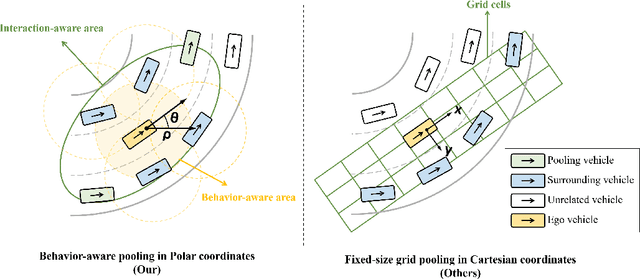
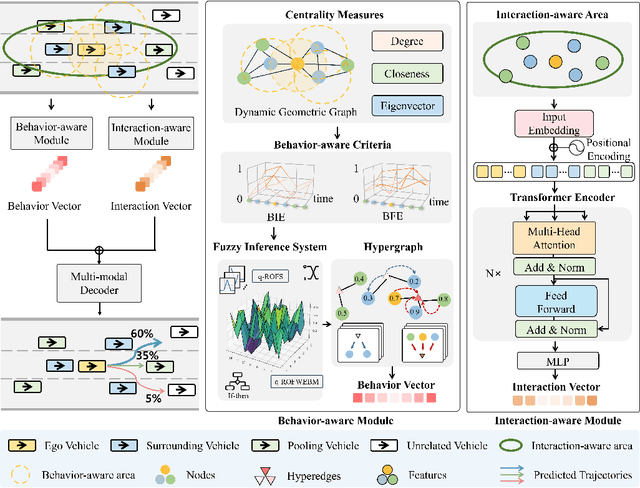
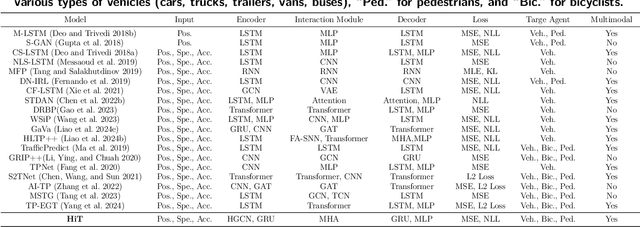
Predicting the trajectories of vehicles is crucial for the development of autonomous driving (AD) systems, particularly in complex and dynamic traffic environments. In this study, we introduce HiT (Human-like Trajectory Prediction), a novel model designed to enhance trajectory prediction by incorporating behavior-aware modules and dynamic centrality measures. Unlike traditional methods that primarily rely on static graph structures, HiT leverages a dynamic framework that accounts for both direct and indirect interactions among traffic participants. This allows the model to capture the subtle yet significant influences of surrounding vehicles, enabling more accurate and human-like predictions. To evaluate HiT's performance, we conducted extensive experiments using diverse and challenging real-world datasets, including NGSIM, HighD, RounD, ApolloScape, and MoCAD++. The results demonstrate that HiT consistently outperforms other top models across multiple metrics, particularly excelling in scenarios involving aggressive driving behaviors. This research presents a significant step forward in trajectory prediction, offering a more reliable and interpretable approach for enhancing the safety and efficiency of fully autonomous driving systems.
DEMO: A Dynamics-Enhanced Learning Model for Multi-Horizon Trajectory Prediction in Autonomous Vehicles
Dec 30, 2024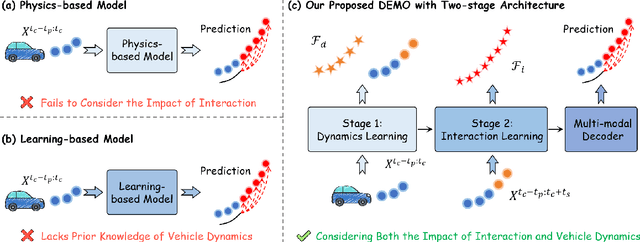
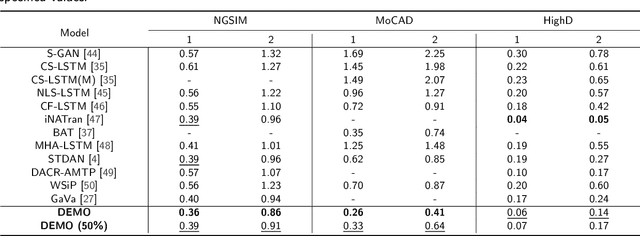
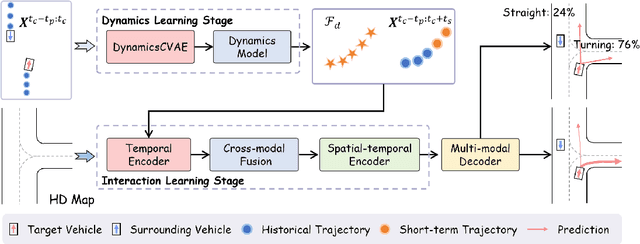
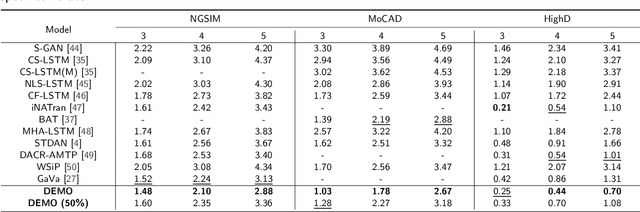
Autonomous vehicles (AVs) rely on accurate trajectory prediction of surrounding vehicles to ensure the safety of both passengers and other road users. Trajectory prediction spans both short-term and long-term horizons, each requiring distinct considerations: short-term predictions rely on accurately capturing the vehicle's dynamics, while long-term predictions rely on accurately modeling the interaction patterns within the environment. However current approaches, either physics-based or learning-based models, always ignore these distinct considerations, making them struggle to find the optimal prediction for both short-term and long-term horizon. In this paper, we introduce the Dynamics-Enhanced Learning MOdel (DEMO), a novel approach that combines a physics-based Vehicle Dynamics Model with advanced deep learning algorithms. DEMO employs a two-stage architecture, featuring a Dynamics Learning Stage and an Interaction Learning Stage, where the former stage focuses on capturing vehicle motion dynamics and the latter focuses on modeling interaction. By capitalizing on the respective strengths of both methods, DEMO facilitates multi-horizon predictions for future trajectories. Experimental results on the Next Generation Simulation (NGSIM), Macau Connected Autonomous Driving (MoCAD), Highway Drone (HighD), and nuScenes datasets demonstrate that DEMO outperforms state-of-the-art (SOTA) baselines in both short-term and long-term prediction horizons.
Real-time Accident Anticipation for Autonomous Driving Through Monocular Depth-Enhanced 3D Modeling
Sep 02, 2024


The primary goal of traffic accident anticipation is to foresee potential accidents in real time using dashcam videos, a task that is pivotal for enhancing the safety and reliability of autonomous driving technologies. In this study, we introduce an innovative framework, AccNet, which significantly advances the prediction capabilities beyond the current state-of-the-art (SOTA) 2D-based methods by incorporating monocular depth cues for sophisticated 3D scene modeling. Addressing the prevalent challenge of skewed data distribution in traffic accident datasets, we propose the Binary Adaptive Loss for Early Anticipation (BA-LEA). This novel loss function, together with a multi-task learning strategy, shifts the focus of the predictive model towards the critical moments preceding an accident. {We rigorously evaluate the performance of our framework on three benchmark datasets--Dashcam Accident Dataset (DAD), Car Crash Dataset (CCD), and AnAn Accident Detection (A3D), and DADA-2000 Dataset--demonstrating its superior predictive accuracy through key metrics such as Average Precision (AP) and mean Time-To-Accident (mTTA).
World Models for Autonomous Driving: An Initial Survey
Mar 05, 2024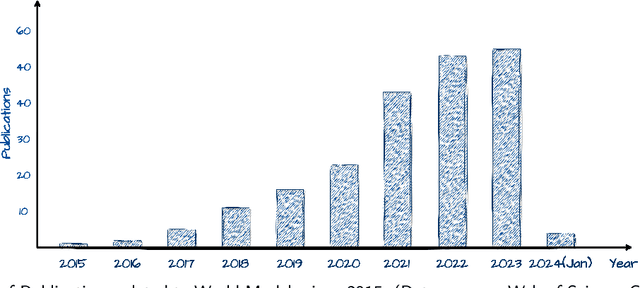
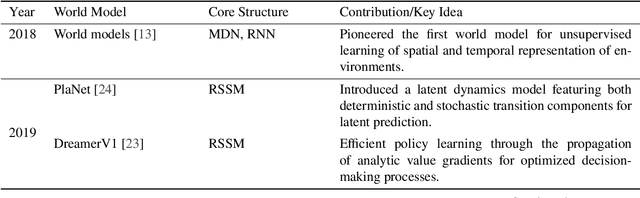
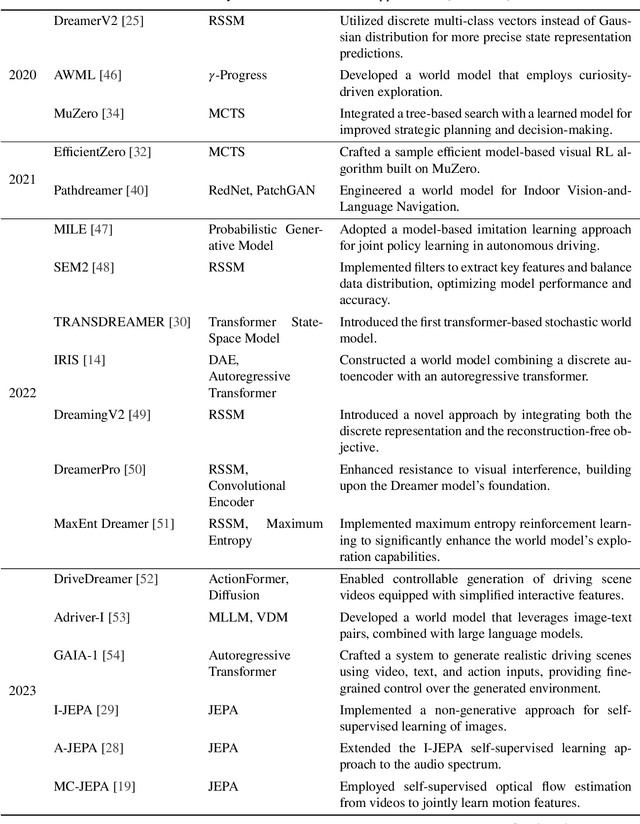
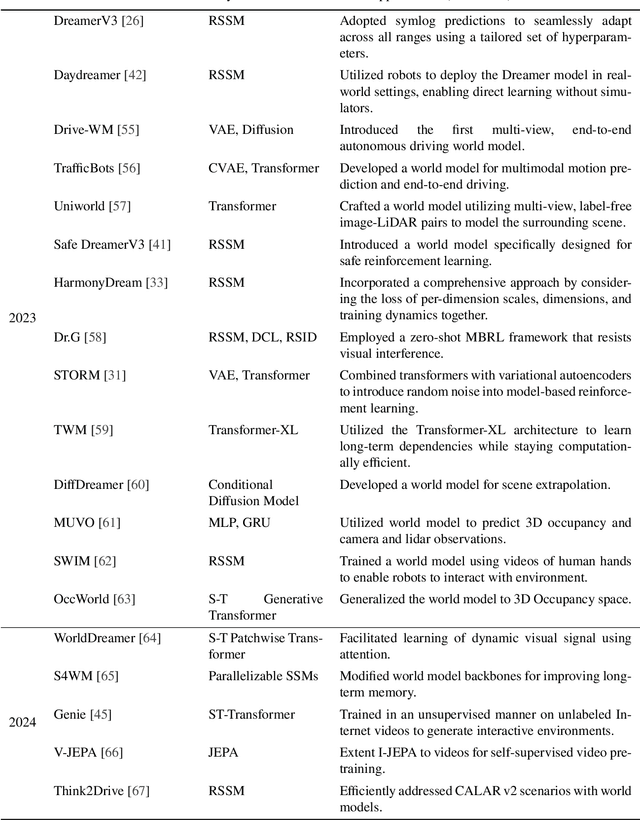
In the rapidly evolving landscape of autonomous driving, the capability to accurately predict future events and assess their implications is paramount for both safety and efficiency, critically aiding the decision-making process. World models have emerged as a transformative approach, enabling autonomous driving systems to synthesize and interpret vast amounts of sensor data, thereby predicting potential future scenarios and compensating for information gaps. This paper provides an initial review of the current state and prospective advancements of world models in autonomous driving, spanning their theoretical underpinnings, practical applications, and the ongoing research efforts aimed at overcoming existing limitations. Highlighting the significant role of world models in advancing autonomous driving technologies, this survey aspires to serve as a foundational reference for the research community, facilitating swift access to and comprehension of this burgeoning field, and inspiring continued innovation and exploration.
A Deep Reinforcement Learning Approach for Traffic Signal Control Optimization
Jul 13, 2021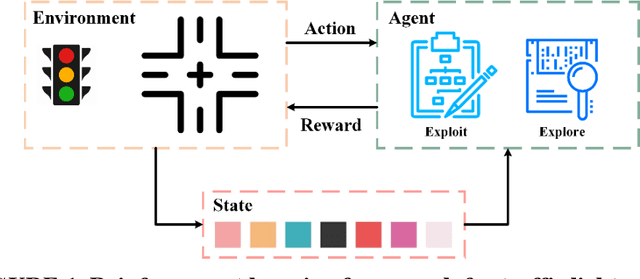
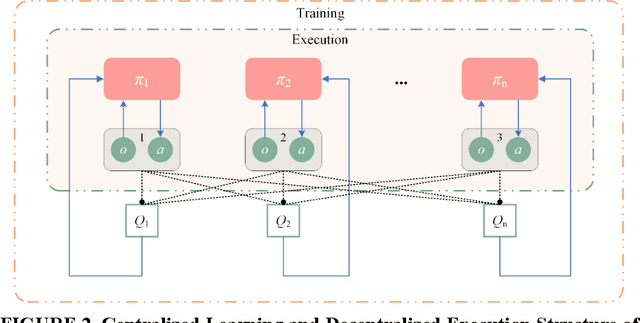
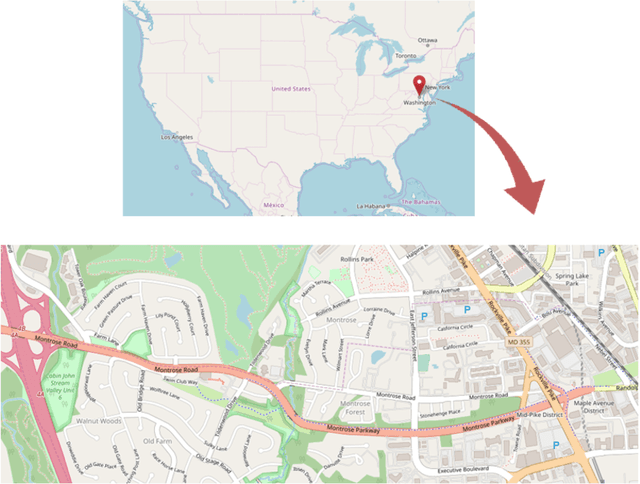
Inefficient traffic signal control methods may cause numerous problems, such as traffic congestion and waste of energy. Reinforcement learning (RL) is a trending data-driven approach for adaptive traffic signal control in complex urban traffic networks. Although the development of deep neural networks (DNN) further enhances its learning capability, there are still some challenges in applying deep RLs to transportation networks with multiple signalized intersections, including non-stationarity environment, exploration-exploitation dilemma, multi-agent training schemes, continuous action spaces, etc. In order to address these issues, this paper first proposes a multi-agent deep deterministic policy gradient (MADDPG) method by extending the actor-critic policy gradient algorithms. MADDPG has a centralized learning and decentralized execution paradigm in which critics use additional information to streamline the training process, while actors act on their own local observations. The model is evaluated via simulation on the Simulation of Urban MObility (SUMO) platform. Model comparison results show the efficiency of the proposed algorithm in controlling traffic lights.